
Film in Hospital in Italy: Rosa Ferro on presence, participation and working inside the hospital community
“Blood tests tell you nothing about the results of our work”
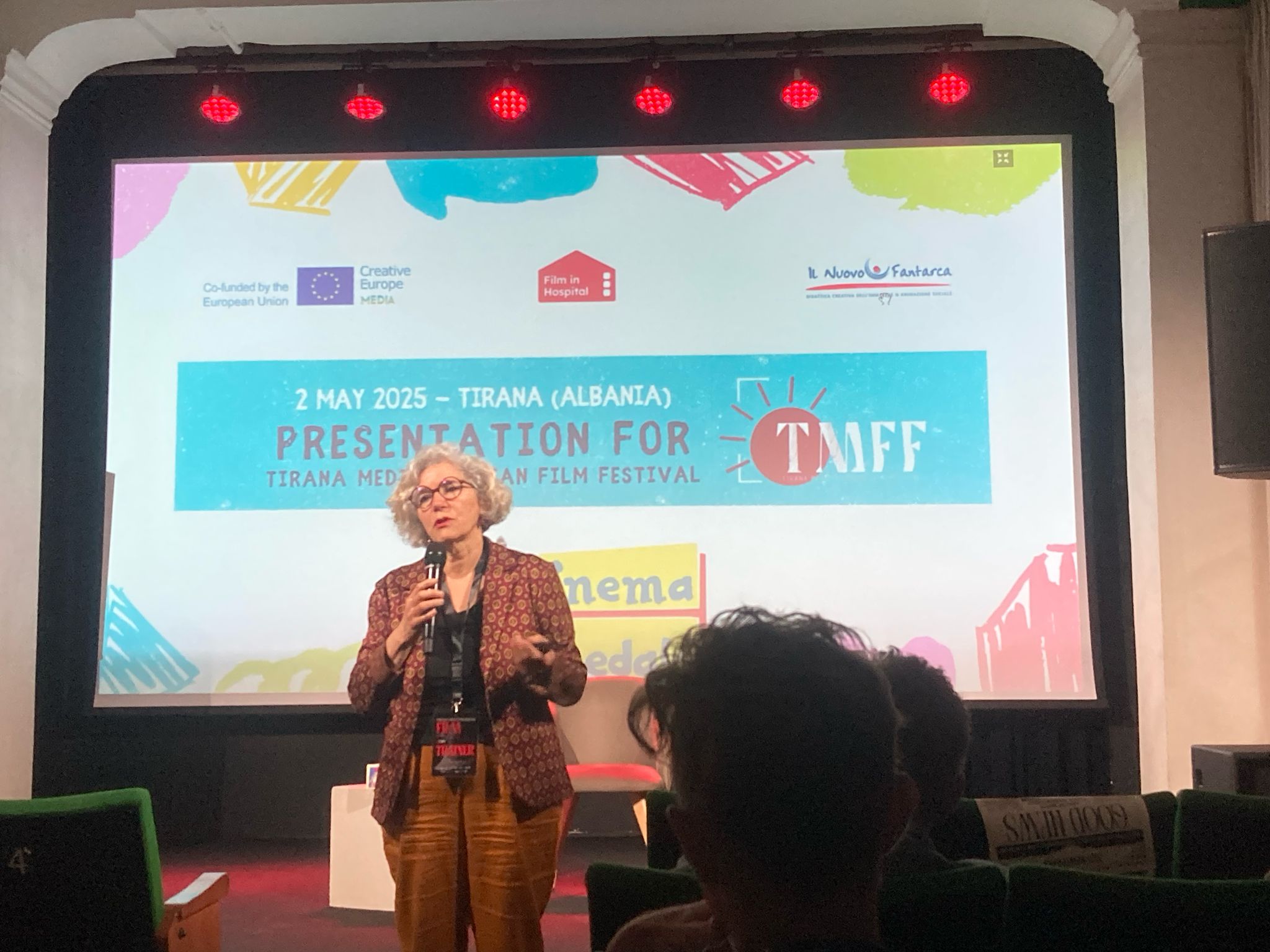
Film in Hospital is developed through a European collaboration of organisations working across children’s film, film education and audience development, with each partner adapting the project to its own healthcare context. In this conversation, Rosa Ferro of Il Nuovo Fantarca reflects on the Italian experience, where regular in-hospital presence, work with hospital schools and close collaboration with healthcare professionals have become central to the programme. Her perspective offers a concrete example of how one partner has developed the Film in Hospital approach locally – and what the wider network can learn from that experience.
How is the Film in Hospital project going in Italy?
Rosa Ferro: Very well. Already 37 hospitals have joined, and interest keeps growing, but there are always obstacles to face. The authorisation process to launch a project – even a digital one – in an Italian hospital can take two to three years. Poor internet coverage in many hospitals is another problem, because our digital platform is crucial to the project. Bureaucratic aspects and technology are our greatest obstacles.
What does your calendar look like? Do you follow the school year timetable, or does the project run on an ongoing basis?
Ferro: The platform, which is the digital component of the project, is available at all times. And during the school year, from September to the end of May, we work with the hospital schools. In Puglia, my region, we are also physically present in the hospitals: once a week in Lecce and twice a week in Bari. On these occasions, we organise film screenings for groups of children, often together with their parents. The discussion that follows allows them to express their emotions. Afterwards, we run a workshop related to the film; it might focus on the central theme, a particular emotion, a colour, or some other characteristic. This gives children the chance to talk even more and to build relationships with others. When children are bedridden, we go from bed to bed to watch films or create animations with them individually. Sometimes we spend as long as two hours with one child. That’s how you develop a personal bond, much more personal than through online contact.
Hospitals are becoming increasingly impersonal places that can make you feel completely ‘dehumanised’. What have you learned about hospitals as a place?
Ferro: Children’s hospitals are different, because patients need a different kind of attention. The huge Giovanni XXIII hospital in Bari is dedicated exclusively to children. They come from all around southern Italy and even from war-torn areas, and every child receives a great deal of individual attention. Last year, we organised a series of themed activities focusing on ‘empowerment’ and their rights as patients. We found that they did not feel reduced to being patients, to being children with an illness; they were full of gratitude towards the doctors, nursing staff and volunteers. There are always minor grievances, for example about hospital food, but there is a strong sense of community. Our project is part of that community, and that is how we should approach it: not as a mission in itself, but as part of a larger whole, which you cannot and must not carry out on your own.
What has helped the project take root so strongly in Italy?
Ferro: We are making a difference by being present in the hospitals. As educators, we can meet the children we work with not only online. In remote hospitals, such as those in northern Italy or Sicily, we organise training for doctors, volunteers, and psychologists. We stay and work with them for a few days so they can observe our methods, and a few months later we check how things are going. This is a sign of respect for the community that you’re a part of. You can’t be part of a network from behind your computer screen.
You often emphasise: ‘We’re not health educators, we’re not art educators, we are film educators,’ but the project is about so much more than film education.
Ferro: All our workers are specialised in different aspects of media education: stop-motion animation, drawing, photography, music and voice recording (sometimes children dub one of the films, or add voices to a film with no dialogue), editing, or directing. For instance, I’m specialised in analysing film language. We decide every three months which activities we’re going to focus on; our system is very dynamic. We use different methods for children who stay in hospital long-term, such as those in the neuropsychiatric ward, children with a rare condition or those receiving palliative care. This is different from working with children who are admitted for a shorter period.
You’ve listed all those specialisms, yet none of them specialise in child psychology!
Ferro: What we do is not cinema therapy! All of us combine different roles, but every one of our educators is also a health worker. As well as being an educator, I am a counsellor, serving as a link between educator and psychologist. The hospital’s psychologists are available to us, but we only call on them for specific assignments. For example, when we take children on a summer holiday. Last year, we took a group of 25 kids to the mountains; doctors, psychologists and teachers were part of our team. This year, we were invited to sail on a boat run by Nave Italia – an educational inclusion project – with 12 teenagers living with a rare condition. Together with teachers, doctors and musicians, we organised a stop-motion workshop. Using our Cinema in Ospedale platform, the teenagers created an animation, writing the dialogue and providing the sound. The result was the short film THE WIND IS NOT VISIBLE. To make such fantastic experiences possible, you need a specialised team.
What began quite simply with a few film screenings in a hospital has now grown into an initiative that is completely interwoven with the children’s lives, even when they go on holiday. You are deeply involved in the entire hospital ecosystem.
Ferro: Our core area of expertise remains art and film; we facilitate encounters between children and art. In doing so, we can bring about significant change: the project reduces isolation, lowers anxiety and improves the quality of life for children during their hospital stay, while also strengthening their internal support network. Another key benefit is that the project bridges the gap with education, as children who spend a long time in hospital tend to fall behind in their studies and see their learning abilities decline.
How important are individual stories to you within that bigger picture?
Ferro: Self-reflection is an important part of well-being. When I talk about myself and put my fears into words, this sets things in motion. It forms part of the humanisation of care and health in general. Talking about your situation helps you accept it and experience it differently. This improves your well-being; scientific findings show this time and again.
How do you measure the impact?
Ferro: Through our many conversations. The kids’ activity during the workshops serves as an evaluation. We don’t have the competence to determine exactly, ‘Now you feel better!’ We’re not doctors, and blood tests tell you nothing about the results of our work, however tempting that may sound. But we see that children feel better when they’re together, when they’re having conversations or being creative in workshops. That’s the most important result. Of course, we have measurable figures for the number of films watched on our platform, the comments children write about them, and the way they engage with the interactive task cards, which they find on the platform. Another indication is that projects such as ‘Film in Hospital’ are on the rise in Italy, even when organised by other associations. In other words: we have set a precedent!
Has that impact ever been quantified in terms of statistics?
Ferro: Two years ago, we asked the Università Cattolica in Milan to conduct a survey, so that we could gain a better understanding. They looked into which films were preferred, how patients were using the platform, and on which devices – mobile phones, tablets, etc. This yielded some interesting results. And, of course, there are the teachers. They mostly say that the project helps them take a more dynamic approach to teaching. For example, in the hospitals of Foggia and Bari, teachers draw up their annual programme based on the films available on our platform. The thematic filter makes it easy for them to find all the films and educational materials on a particular theme.
You don’t just stick to regular screenings.
Ferro: In May, we organise the annual Cineo Festival. Children in all participating hospitals watch eight selected films and vote for their favourite. And on one particular day, we invite 200 people from the children’s families, schools and wider social circles to the cinema, to build a bridge between the worlds inside and outside the hospital. This form of sensitisation helps children, teachers and parents understand the living conditions of children while they are staying in hospital.
When you first set up the cooperative society Il Nuovo Fantarca, you probably thought you’d be spending all your time at the cinema. Now, the hospital has become your second home. Do you still have time for other projects?
Ferro: We do! We run a wonderful film and theatre project for young people in prison, and we support numerous other initiatives in film and arts education, but the hospital project is unique. People in hospital live in their own small community, and we cannot simply roll out our workshops for them. We have to rethink and tailor our project every day, for each child you meet.
Which type of films works best on the platform?
Ferro: Short films! The perception of time in hospital is completely different from that in everyday life. Only older children prefer longer films, but the choice is limited. We have far more films for the 3–12 age group. There is still room for improvement for 14- to 16-year-olds.
On what basis do you work with film distribution companies?
Ferro: It was difficult at first; distributors were asking for far too much money. It took us a whole lot of emails to persuade them to lower their prices. But these days, we’re on friendly terms with most of them. Sometimes they offer us a film for free, or they ask how much we can afford to pay. We have around 150 films on the platform, mostly on long-term contracts, so the future is secured. If distributors and producers had a better understanding of our audience, they would realise there are opportunities here. This project always makes for an enriching experience for them.
When Il Nuovo Fantarca joined Film in Hospital, could you have imagined where the work would lead?
Ferro: Not at all. I knew nothing about the reality of life in hospitals. The first year we had just €9,800 in European funding, which we used to set up the platform and buy the rights to the first films. The project was first launched in Belgium by JEF, then joined by Kids Meet Art (Croatia) and BUFF (Sweden). In 2020, in the midst of the pandemic, Italy, Spain and Slovenia joined, followed by Germany and Greece. One of the strengths of Film in Hospital is that partners work in different healthcare, educational and cultural contexts and can learn from one another’s approaches. In Italy, at first, we thought it would be enough simply to set up a platform. But once COVID was behind us, it became clear that we also had to go inside the hospitals and meet the children there. That became a crucial part of our Italian practice – and an experience we could bring back into the wider network.
Gert Hermans


